Click on any image for a larger version
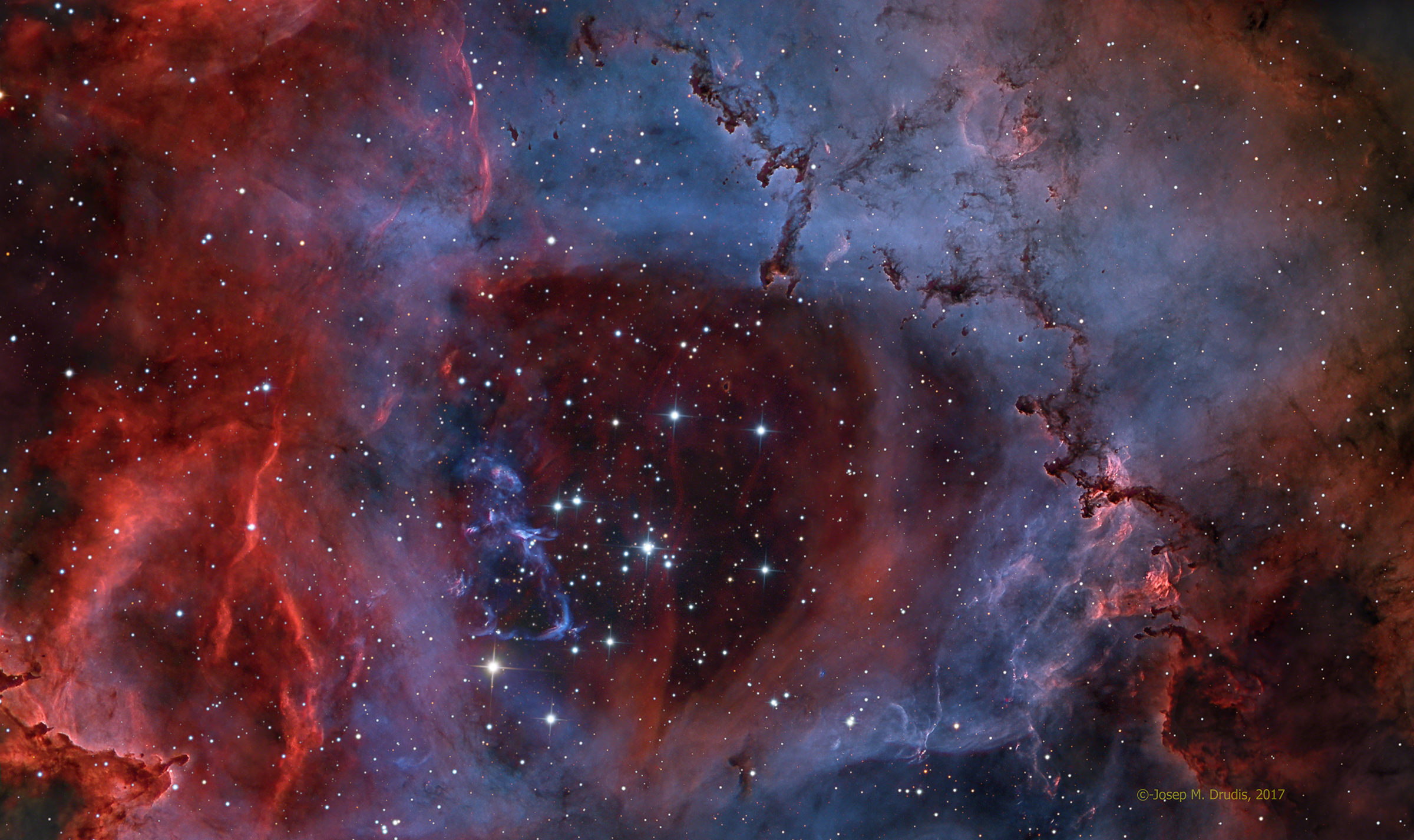
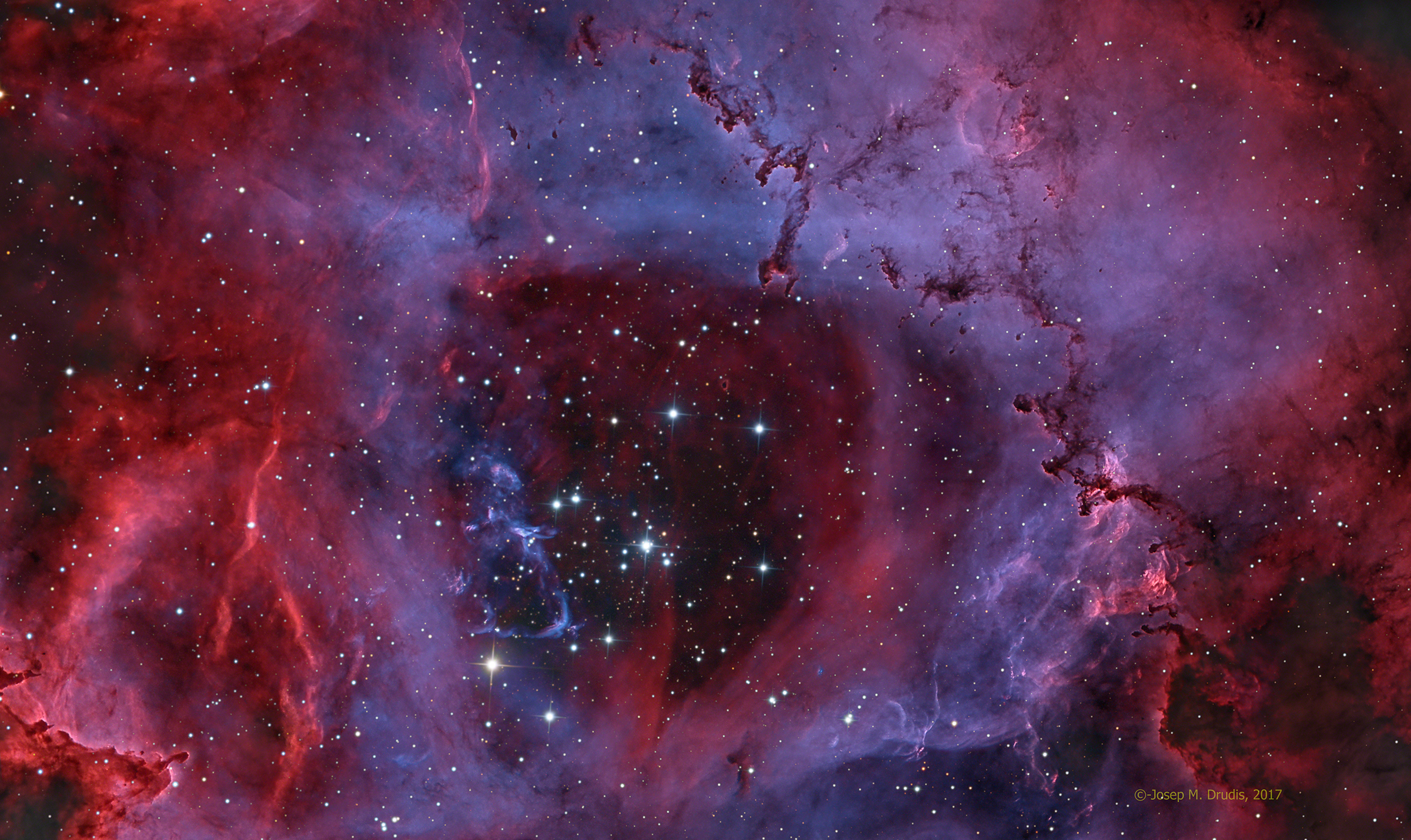
The Rosette Nebula is a quite large (90×65 arcmin) emission nebula, located in the constellation Monoceros (Unicorn). It is usually referred to as NGC 2237, but the whole complex is composed of an open cluster (NGC 2244, Caldwell 50), which is responsible for the nebula’s central structure, and several gas clouds that shape its final appearance. The very hot, big stars in it are blowing away the Rosette’s gas cloud. The brighter stars are 12 Mon (the red bright star located near the center, to the lower left, which is not part of the cluster, just a foreground star) HD 46223, a O4V massive (50 solar masses) blue star, located just below right of 12 Mon and HD 46150, an O5V, 60 solar masses, blue star, located at the center of the central bubble. These latter stars are part of the cluster. As nebulosities, NGC 2237, 2238, 2239 and 2246 conform the whole nebula, that we usually know with the generic name of NGC 2237.
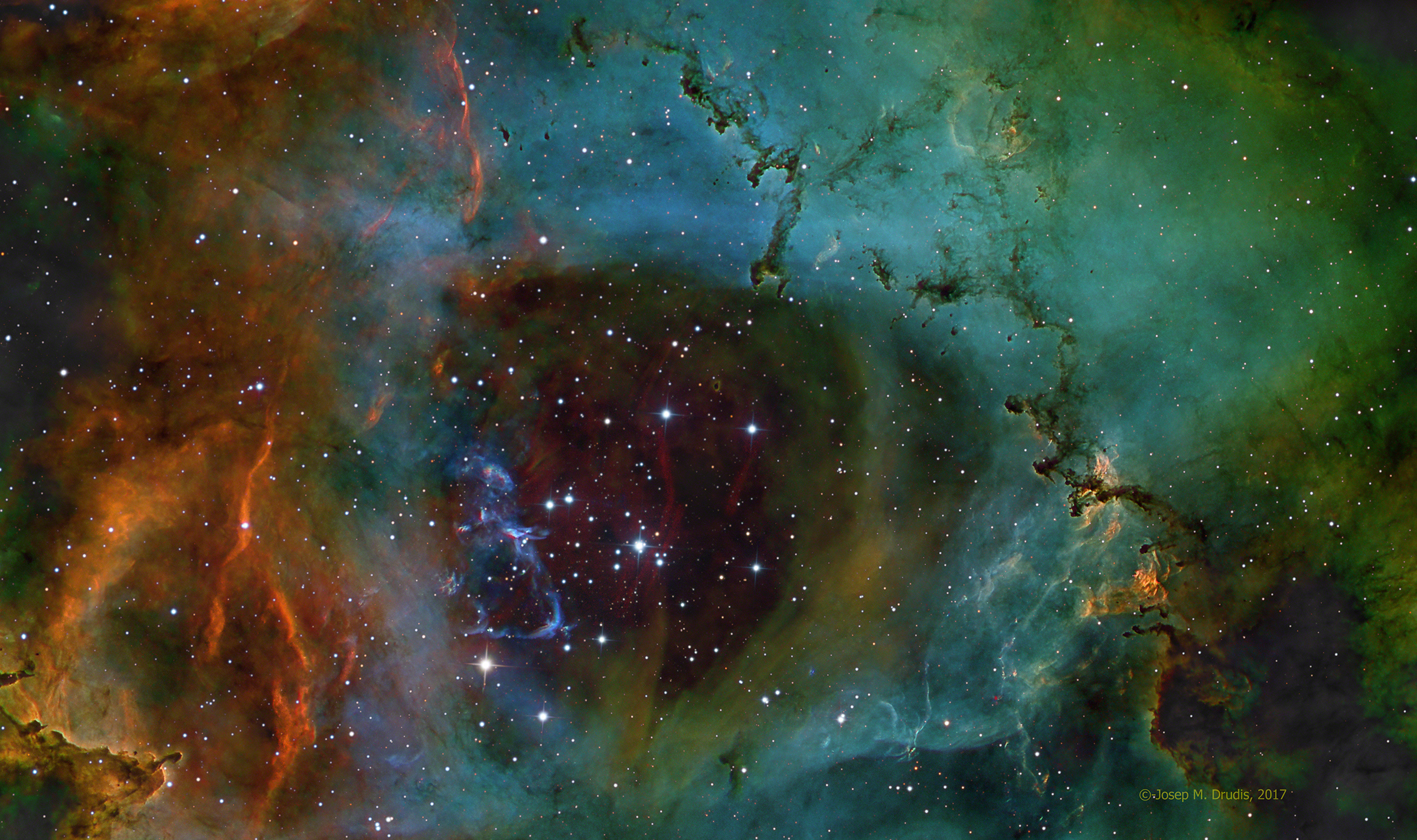
The fact that this 2×1 mosaic has been essentially taken in narrowband, allows us to discern between its differences in composition. The central region is rich in Oxygen, here mapped to blue and its periphery is richer in Hydrogen and Sulphur (this latter one, especially on the Eastern -left- side). The higher contrast obtained with narrowband filters allow for crispier detail on the specific structures of the nebula. This nebula is a star birth region and abounds in YSOs (Young Stellar Objects). J. DiFrancesco et al. (Astronomy & Astrophysics, 518, article no. L91.) determined, with the Herschel Telescope, in 2010 that at least 102 clumps containing protostellar objects (YSOs) were found in the Rosette nebula, revealing its star birth potential.
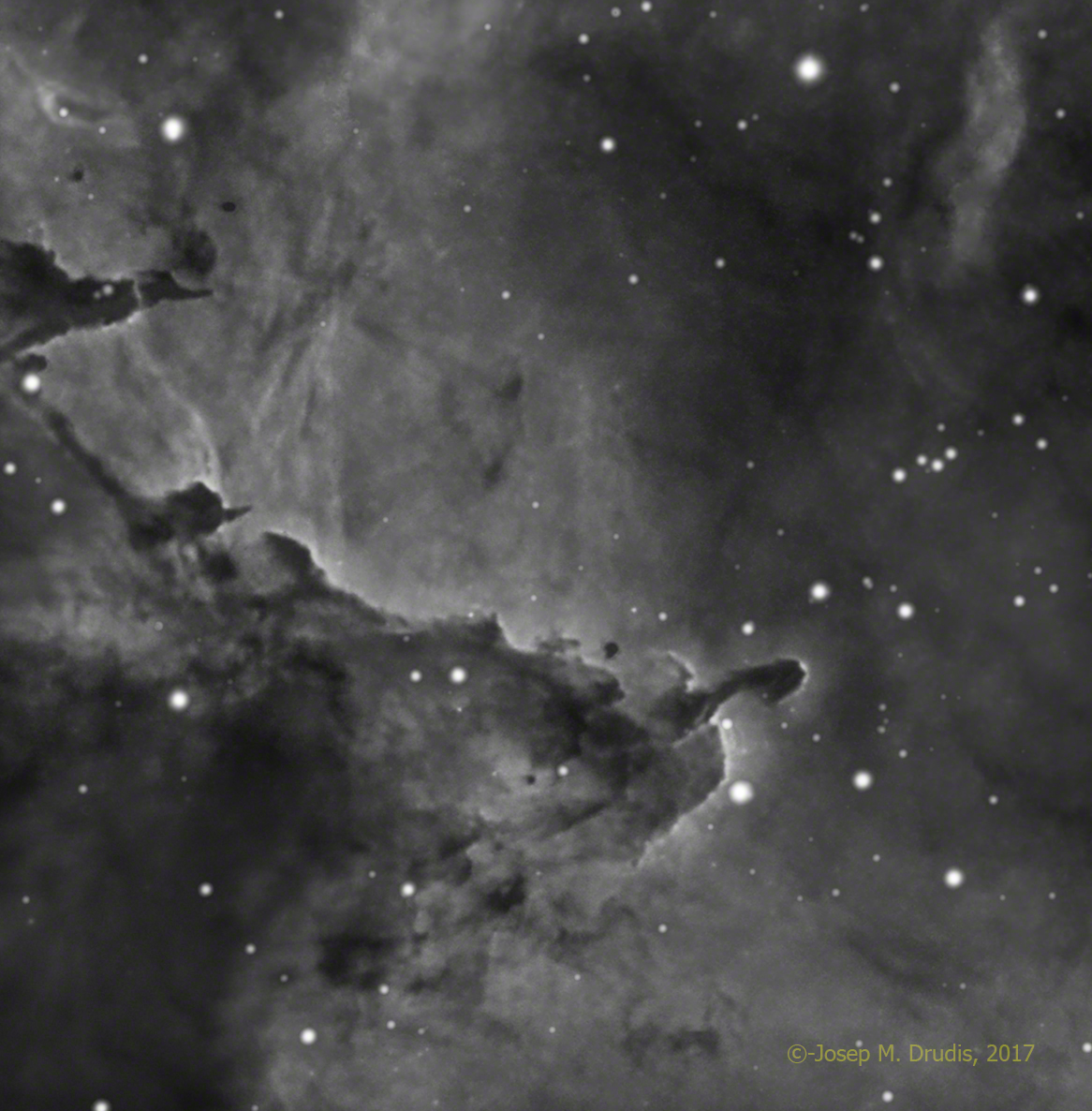
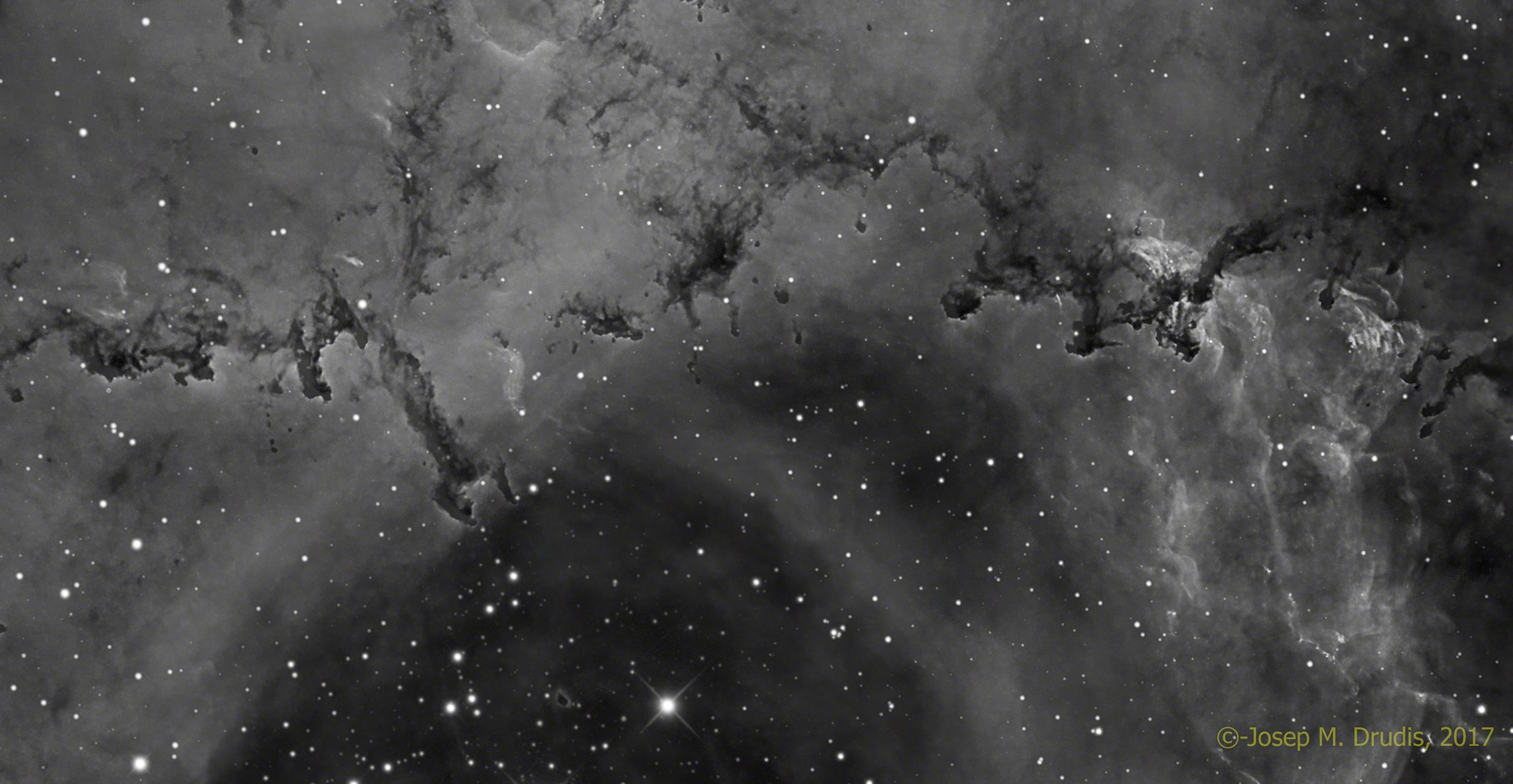
It is interesting to show two cropped regions, as they depict the two most conspicuous dark (dust containing) nebulosities in this frame:
Additional Information
Object
Name(s): NGC 2237. The Rosette nebula
Type: Emission Nebula
RA: 06h 31m 53s
Dec: +04º 56’ 29”
Constellation: Monoceros
Size (arcmin): 90×65
Magnitude: +4.8
Distance: 5,200 ly
Image
Date: many nights from 2016-11-06 thru 2017-03-27
Location: iTelescope.net, SSO near Coonabarabran, NSW Australia
Size (arcmin): 59.5×36
Telescope: Planewave CDK 20” f/6.8
Camera: SBIG STX16803 (4096x4096pix)
Guiding: Astrodon MonsterMOAG off-axis guider
Total exposure: 26.5 hours (Ha: 11h; OIII: 6.5h; SII: 6h; RGB (only stars): 3h) Mosaic 2×1.
Processing: CCDStack, Photoshop CC 2017